What it means
What this says about buying a battery
A home battery is sold on how much it holds, although on a time-of-use tariff that is not the number that decides your bill. Past a certain size, a bigger battery earns nothing. Here is where that size comes from, on a real year of Colorado data.
First finding
The schedule barely matters
No clever timing is needed to capture the savings.
On the summer weekday there is no single best plan, because 2,448 plans all cost the same. All 2,448 agree on only four decisions.
Run the house off the battery in all four peak hours. Nothing else. The other twenty hours are a free choice, because every one of them costs the same. Charging at midnight and charging at two in the afternoon give you the same bill.
So none of the value comes from clever timing. A plain wall timer would capture all of it, since on a tariff with two prices there is nothing left for smart software to improve. A tariff with more price levels would be a different question.
The surprise
A bigger battery earns nothing
A battery has two numbers: how much it holds, and how fast it can empty. Both of them stop mattering.
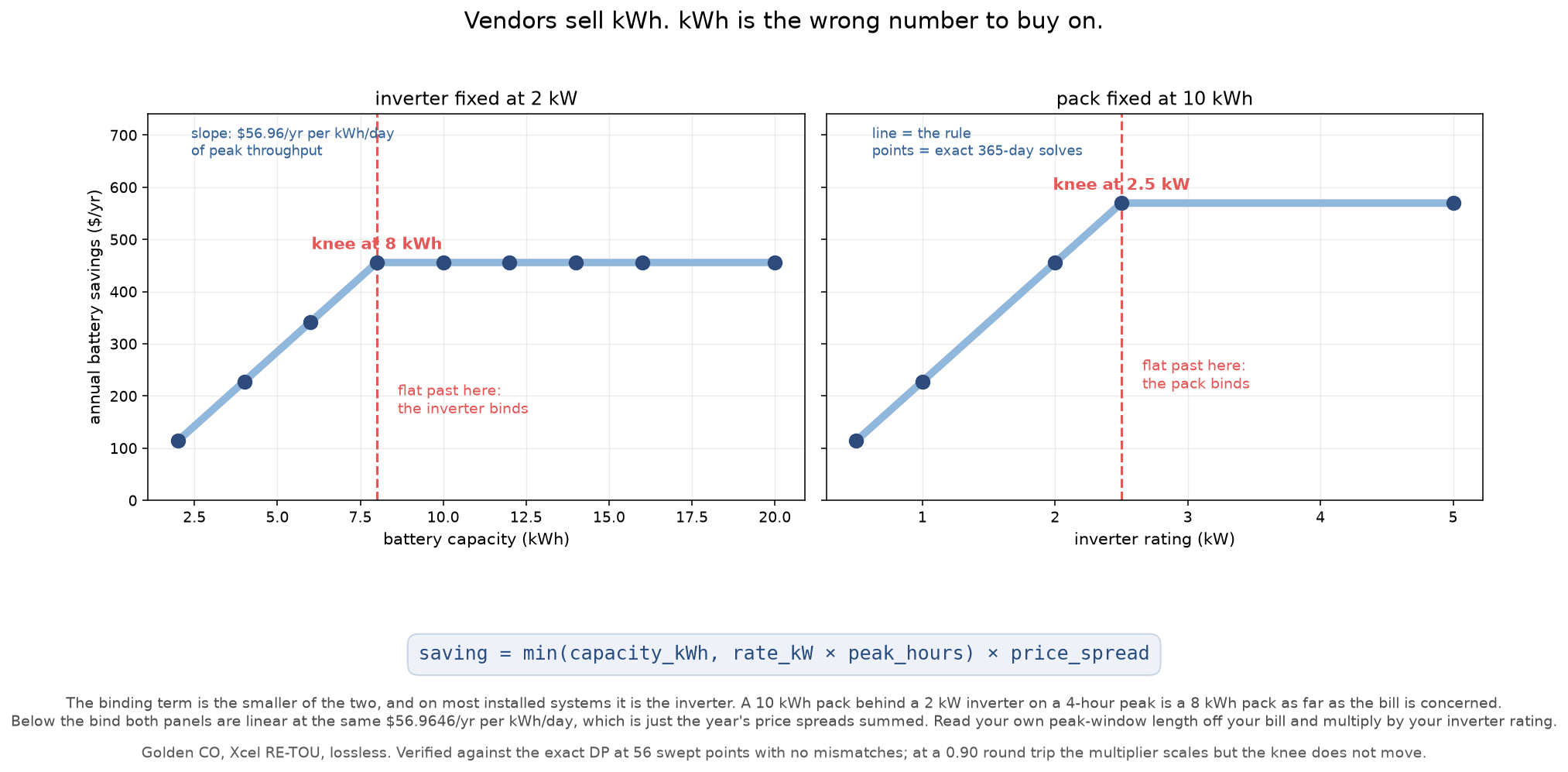
How much it holds, at 2 kWh/hr
2 kWh
$0.48
4 kWh
$0.97
6 kWh
$1.45
8 kWh
$1.93
10 kWh
$1.93
12 kWh
$1.93
16 kWh
$1.93
20 kWh
$1.93
How fast it empties, at 10 kWh
0.5 kWh/hr
$0.48
1.0 kWh/hr
$0.97
2.0 kWh/hr
$1.93
2.5 kWh/hr
$2.42
5.0 kWh/hr
$2.42
Savings rise in a straight line up to 8 kWh, then stop. 10 kWh, 12, 16 and 20 all save the same $1.93 a day.
The expensive hours last four, with the battery pushing out 2 kWh in each of them. Four hours at 2 kWh is 8 kWh, and then the expensive hours are over, so the last 2 kWh of a 10 kWh battery never moves.
Speed runs out too. In the second table, 2.5 kWh an hour and 5.0 kWh an hour both save $2.42, because a 10 kWh battery at 2.5 kWh an hour already empties completely during the four expensive hours. Going faster does not help when there is nothing left in it to move.
What actually earns anything
the smaller of what it holds
and what it can push out
A 10 kWh battery at 2 kWh an hour delivers 8 kWh over four expensive hours. The other 2 kWh may as well not be there.
Does it hold elsewhere?
The rule holds on other tariffs
Colorado has a four-hour peak. Three more were built to test the rule at other lengths.
| Peak length | Window | Rule predicts | Measured knee | Daily ceiling |
|---|---|---|---|---|
| 3 hours | 6 to 9 PM | 6 kWh | 6 kWh | $1.45 |
| 4 hours | 5 to 9 PM | 8 kWh | 8 kWh | $1.93 |
| 5 hours | 4 to 9 PM | 10 kWh | 10 kWh | $2.42 |
| 6 hours | 3 to 9 PM | 12 kWh | 12 kWh | $2.90 |
The point where savings stop lands exactly where the rule says, every time. Across 56 separately solved cases there were no misses, which means this comes from the shape of any two-price tariff, not from one Colorado bill.
The practical part
Two numbers that only mean something together
Two upgrades to the same battery, each priced over a full year on the real tariff.
Emptying faster, 2 to 2.5 kWh an hour
Same size. 2.5 is 10 kWh over four hours, so above it nothing more is earned.
+$101.07/yr
A battery twice the size
Twice the storage, same speed. 10 kWh to 20 kWh.
+$0.00/yr
Doubling the size earns nothing, while going from 2 to 2.5 kWh an hour earns 25% more. That second number is not a round figure someone picked, because 2.5 is 10 kWh divided by four expensive hours, which is the speed at which this battery just manages to empty itself before the peak ends.
That is why the upgrade stops there. Below 2.5 the battery cannot get all of itself out in time, so part of it goes unused. Above 2.5 the battery is already empty before the peak ends, so extra speed has nothing to move. The table above shows 5.0 kWh an hour earning the same as 2.5.
Below that point, every extra kWh a day the battery can push out during the expensive hours adds $56.96 a year. Exactly, not roughly. That figure is the year's price gaps added up: 86 summer weekdays at $0.242, 175 winter weekdays at $0.207, and 104 weekends at nothing. So any change that moves 2 kWh a day comes to $113.93 a year, whatever the change is. Going from 2 to 2.5 kWh an hour takes what the battery can deliver from 8 to 10, which is $113.93 before losses and $101.07 after them.
So there is no single number to shop on, because size and speed only mean anything together. What you want is a battery that just empties itself over the expensive hours, with nothing spare on either side. The rule is three steps:
- 1. Count the expensive hours on your bill. On this Colorado tariff there are four, from 5 to 9 PM.
- 2. Divide the battery's size by that number. A 10 kWh battery divided by four hours is 2.5 kWh an hour.
- 3. That is the speed worth paying for: just enough to empty the battery over those hours.
It works the other way round too. If the speed is fixed, multiply it by the expensive hours to get the size worth paying for. 2 kWh an hour over four hours is 8 kWh. Same rule, same two numbers.
A spec sheet quotes two speeds, one for filling and one for emptying, which are often different. The rule uses the emptying one. Only power pushed out during the expensive hours earns anything, so only the speed that governs pushing it out can matter. A battery that fills at 1 kWh an hour and empties at 2 saves the same as one that does 2 both ways.
Filling speed matters only when it is too slow to refill the battery before the next expensive stretch. At 0.5 kWh an hour in against 2 out, the saving falls to $1.45 instead of the $1.93 the rule predicts, because the battery never gets back to full and so cannot empty itself during the peak. Buy on the emptying speed, and check the filling speed is merely adequate rather than matching.
Payback
How long it takes to pay for itself
$404.28 a year, against what these systems cost to install.
| Installed cost | Standard speed | 25% faster | Inside a 10-year warranty? |
|---|---|---|---|
| $5,000 | 12.4 yr | 9.9 yr | Only at 2.5 kWh/hr, barely |
| $7,000 | 17.3 yr | 13.9 yr | No |
| $9,000 | 22.3 yr | 17.8 yr | No |
| $11,500 | 28.4 yr | 22.8 yr | No |
| $14,000 | 34.6 yr | 27.7 yr | No |
At a typical installed cost of about $11,500, the battery pays for itself in roughly 28 years against a 10-year warranty, so it would have to outlive its guarantee nearly three times over. One row clears the warranty: a $5,000 install with the faster battery, at 9.9 years, which clears it by six weeks. That is not a margin to buy on, and $5,000 is below anything being quoted in 2026.
These figures assume the battery loses 10% of what it stores on the round trip, which is what a residential system with its inverter is usually rated at. A lossless one would save $455.72 a year and pay back at $11,500 in 25.2 years.
The other thing that moves these numbers is what the utility pays for power sent back to the grid. Most pay less for an exported kWh than they charge for an imported one, which makes a stored kWh worth more, not less, because it displaces a purchase instead of earning a credit. Solar goes the other way, since a panel that has nowhere cheap to sell earns less.
| Export paid at | Solar earns | Battery earns | Payback at $11,500 |
|---|---|---|---|
| Full retail | $970.61 | $404.28 | 28.4 yr |
| Three quarters | $859.09 | $414.96 | 27.7 yr |
| Half | $747.57 | $441.52 | 26.0 yr |
| A quarter | $636.05 | $469.51 | 24.5 yr |
| A tenth | $569.14 | $486.94 | 23.6 yr |
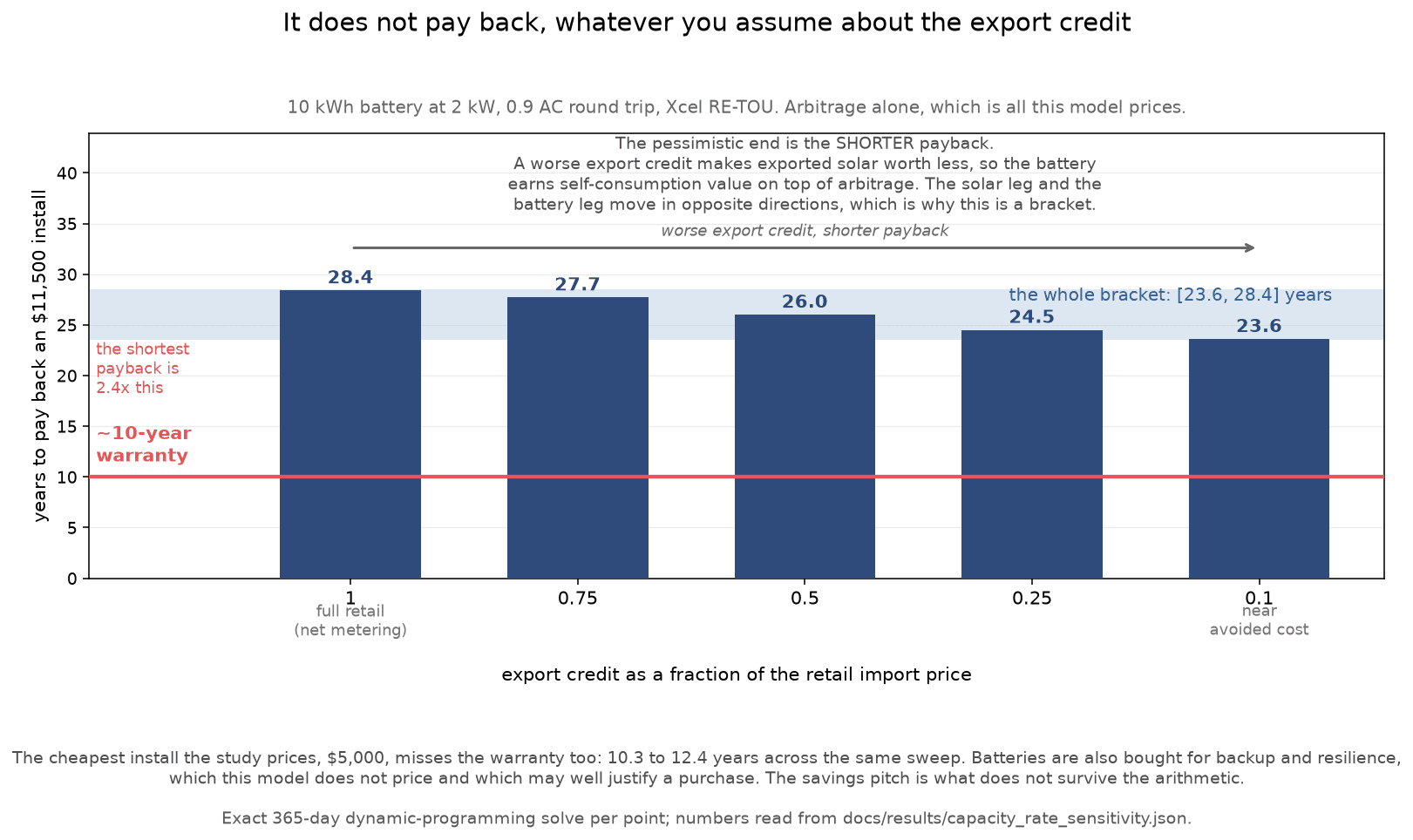
So payback at $11,500 sits between 23.6 and 28.4 years whatever those two assumptions turn out to be, against a 10-year warranty. The answer no longer depends on either of them.
A 10 kWh system runs about $11,500 installed, while a 13.5 kWh one runs about $15,000. EnergySage, which collects quotes from installers, puts the 2026 average at $1,128 per kWh. Vendor sites advertise $700 per kWh at the bottom of their range, although that is the price of the equipment on its own, with nothing fitted. A Tesla Powerwall 3, which holds 13.5 kWh, is $9,300 to $10,500 for the unit and $13,000 to $16,500 installed.
These cost figures come from installer and marketplace sites, not from independent data. They are a range, not a benchmark.
There is no federal tax credit on a battery you buy outright in 2026, because the 30% residential credit, Section 25D, ended on December 31, 2025, going by the date the installation was finished rather than the date you paid. The table never assumed the credit, so no number in it moves. What changed is that a buyer in 2025 could take 30% off the cost column and a buyer in 2026 cannot.
Equipment is only about half to two thirds of a quote. Labor, electrical work and permits are the rest, which is the part that depends on the house. If the main panel needs upgrading, that alone is $2,500 to $4,000. How far the battery sits from the panel, what the local permit office wants and what electricians charge in the area all move the number. Because two neighbors can get different quotes for the same battery, get a quote for your own house rather than using a row from this table.
The sizing rule helps here. An 8 kWh battery earns the same $404.28 a year as a 20 kWh one while costing less. Same savings for less money is a shorter payback, so getting the size right moves you up this table. It does not fix the problem, but it is the part a buyer controls.
The two assumptions behind these figures
This model used to lose no energy in the round trip and assume power sells back at the price it was bought for. Now that both are measured, they turn out not to point the same way.
Losses cost about a ninth of the saving. At a 0.90 round trip the battery earns $404.28 a year instead of $455.72, which pushes payback at $11,500 from 25.2 years to 28.4.
The export credit moves the other way: the worse the credit, the more the battery earns. The solar side moves the opposite way over the same range, which is why the two are never added together.
What could change the answer
Some states pay a battery to be available instead of paying it to save money. Massachusetts pays $275 per kW of average summer performance through Mass Save. Rhode Island pays $225. Both pay per kW, the same number that decides the arbitrage savings here.
Mass Save's own example is a battery averaging 5 kW across the season, earning up to $1,375 a year, which is three times the $455.72 here. The payment goes on average kW delivered across events that run two to three hours, so a single 13.5 kWh battery averages about 4.5 kW at best. Bigger numbers than that mean more than one battery, and more than one battery to buy.
Because my model prices arbitrage and nothing else, the answer could be different where these programs run. Rhode Island's approval runs to the end of 2026.
The conclusion
Savings and backup are different things
On a two-price tariff, moving power from cheap hours to expensive ones does not pay for the hardware within its warranty.
A battery bigger than the rule calls for is not buying savings. It is buying backup. Every extra kWh is more time with power in the house when the grid is down. Nothing in this calculation values that, because the only goal it was given was a smaller bill.
So the savings have a ceiling and the numbers above are it. What backup power is worth is a separate question, although one product is sold against both.
Prior work
What was already known
Sizing batteries under time-of-use rates is a studied problem with published work on it, although I worked this out from my own data rather than from the literature.
What is mine is a count rather than a single schedule. 2,448 schedules tie for cheapest on the summer weekday. The same four hours, discharge from 5 to 9 PM, appear in every one of them, while the other twenty are free.
The count can be checked by hand. Of the twenty free hours, seventeen fall before the peak and three after it. Each schedule places four charging hours among those twenty, but not every placement works. Putting all four before the peak overfills the battery, so at most three can go there. Putting three after the peak leaves too little charge to last the peak, so at most two can go there. That leaves two shapes, three before and one after, or two before and two after, and counting both comes to 2,448.
C(17,3)·C(3,1) + C(17,2)·C(3,2) = 2,040 + 408 = 2,448
That count is what supports a clock setting capturing the whole value. With four hours forced and nothing else determined, there is nothing left to schedule.
The peak-window check stands on its own, with 56 cases re-solved exactly across four peak windows and zero mismatches.
Limits
What this does not cover
One house, one tariff, one year. The rule should hold for any two-price tariff, although the dollar amounts are for this one Colorado home and will not match yours.
The daily figures in the two tables above are for a battery that loses nothing. Losses shrink the gap the battery is working with, from $0.2418 to $0.2148 at a 0.90 round trip, so every daily saving falls by about a ninth. The place where the savings stop does not move, because that depends on how much the battery can deliver rather than on what a delivered kWh is worth. Every sizing conclusion on this page holds either way.
Losses do introduce a floor the lossless model had no notion of. A cycle only pays if the price ratio beats the loss ratio, meaning the expensive price divided by the cheap one has to exceed 1 divided by the round-trip efficiency, which at 0.90 is 1.11. On this tariff the price ratio is 2.74, so there is plenty of room. On a tariff with a spread under about 11% there would be none.
Weekend days on this tariff have one flat price, so they save $0 at any size or speed. No amount of battery helps when there is no price gap to work with.
Nothing here models the battery wearing out. A real one holds less each year and the savings fall with it, so the long-run returns above are too high.
Where these numbers come from
Keep reading